








Ungoverned agent actions
Without runtime controls, AI agents can execute tool calls that exceed their intended scope. AI Trust enforces deny-by-default authorization — every tool call must be explicitly permitted before it executes.
New! KOBIL AI Agent Trust Infrastructure Learn More

The governance layer that gives every AI agent a verified identity, enforces policy at runtime, and produces continuous audit evidence — aligned with EU AI Act, SOC 2, HIPAA, and NIST AI RMF.
OVERVIEW
AI agents are moving into production faster than governance can keep up. Traditional IAM and SIEM were not designed for autonomous, non-human identities operating at machine speed. AI Trust closes that gap — enforcing policy before every action, not after the fact.
APPROACH
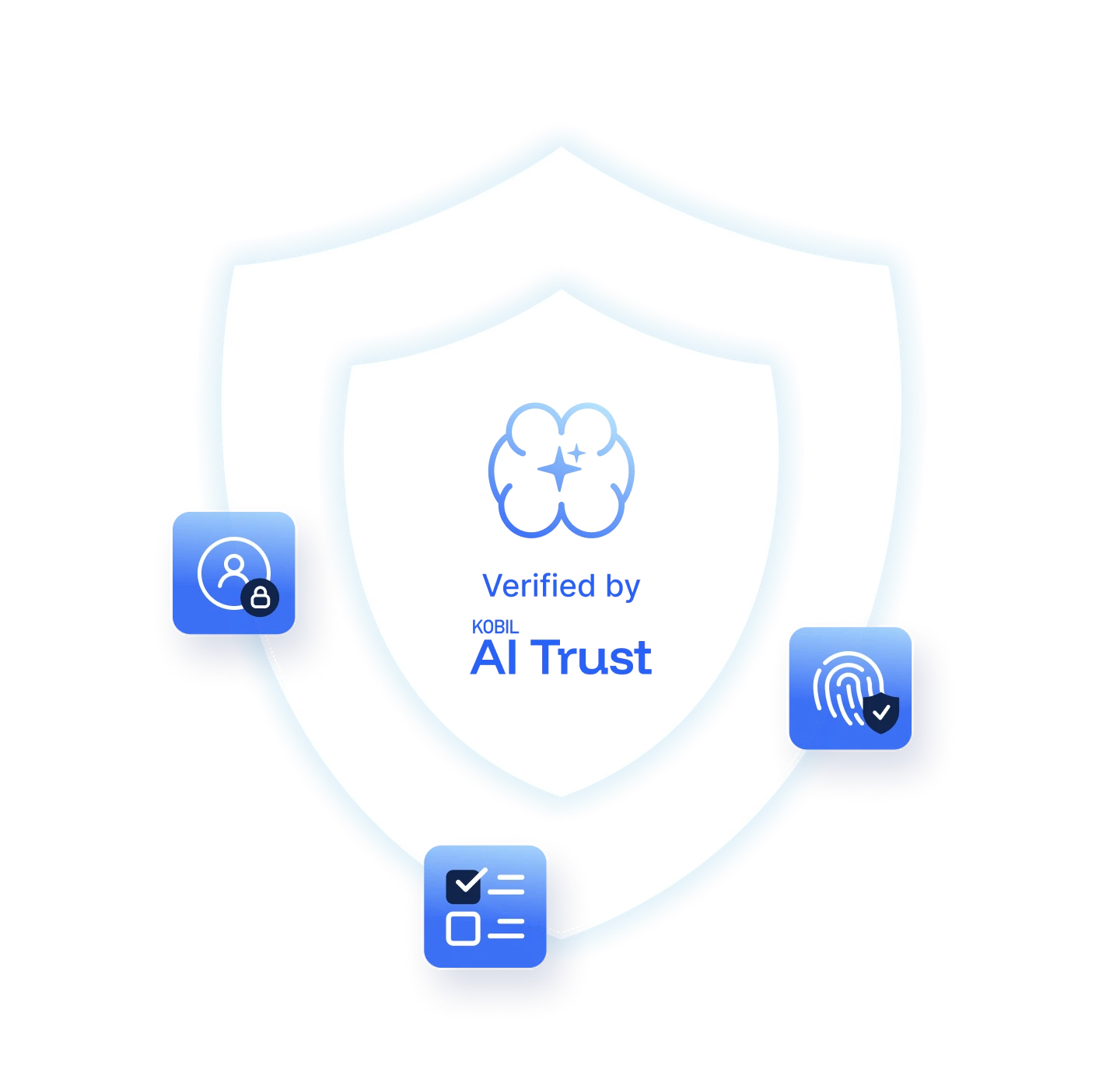
AI Trust operates on three principles applied in sequence.
Identity: who is this agent?
Authorization: what is it permitted to do? Accountability: what did it do,
why was it allowed, and who approved it? Every tool call passes through all three — automatically,
without modifying agent logic.
Identity
Who is this
agent?
Authorization
What is it
permitted to do?
Accountability
What is it
accountable for?
BENEFITS
Without runtime controls, AI agents can execute tool calls that exceed their intended scope. AI Trust enforces deny-by-default authorization — every tool call must be explicitly permitted before it executes.

The Guardian Agent inspects every input and output for prompt injection attempts and jailbreak patterns, blocking unsafe calls before they reach execution.

Every agent receives its own X.509 certificate and OAuth 2.1 credentials. Mutual TLS verifies the agent at connection time — no shared credentials, no impersonation.

For sensitive actions, AI Trust routes approval requests to a designated human approver's device in real time. No approval, no execution.

PII redaction, secret stripping, and network egress filtering run on every agent interaction — preventing sensitive data from leaking through tool calls or API responses.

Every event — token issuance, authorization decision, tool call, human approval — is captured in a tamper-evident audit trail, queryable by period, agent, and event type.
FEATURES
From cryptographic agent identity through runtime enforcement to continuous compliance evidence — three tiers, deployed as one platform.
Every agent receives its own X.509 certificate and OAuth 2.1 credentials. Mutual TLS verifies the agent at connection time — uniquely identifying it across all platform interactions.
Allows additional verification steps for risky or critical actions.
Enables identity and authentication flows across different digital channels to be managed from a single structure.
Provides a secure approval mechanism for actions such as money transfers, contract approvals, or access to sensitive data.
Helps manage which services users can access and under which conditions.
Considers the user’s device as part of the identity verification process.
 AI Agent
Verified agent identity
Human
AI Agent
Verified agent identity
HumanSCENARIOS
Install the SDK for Python or TypeScript. Wrap tool calls. A single configuration point connects all services — no changes to existing agent logic required.
Configure scope bindings, authorization policies, anomaly thresholds, and operating hours through the management API. Policy is enforced centrally, not per agent.
Every agent event streams into a unified audit store. Anomaly detection runs continuously. Policy violations trigger alerts or automatic agent suspension. Compliance reports generate on demand.
Yes. SuperApp does not rely on the default system webview. It uses KOBIL’s hardened, self-protecting webview with certificate pinning, runtime integrity checks and end-to-end encryption, so every Mini App runs inside a trusted, controlled environment.
All data is protected end to end. Communication between the app, Mini Apps and the backend is encrypted, cryptographic keys are bound to the user’s device, and sensitive data is stored in encrypted containers — so neither networks nor third parties can access it.
Yes. The platform can run in the KOBIL cloud, in your private cloud or fully on-premises in your own data center — with the same feature set in every deployment model.
By default the platform is operated in certified European data centers. Depending on your regulatory requirements, it can also run in a region of your choice or inside your own infrastructure.
SuperApp can be used from the shared data center or it can be deployed on desired location. Mini Apps(webapps) and other web assets can be deployed to any desired server.
Mini Apps are updated over the air: you publish a new version to your Mini App store and users receive it instantly, without app-store review cycles. Only updates to the native shell follow the regular store process.
Completely. Colors, fonts, icons and layouts are fully white-label — you build the experience under your own brand, and every surface can follow your corporate design guidelines.
No. KOBIL does not charge commissions on payments running through the platform. You keep full control over your payment flows and the business models you offer your partners.
Yes. SuperApp does not rely on the default system webview. It uses KOBIL’s hardened, self-protecting webview with certificate pinning, runtime integrity checks and end-to-end encryption, so every Mini App runs inside a trusted, controlled environment.
All data is protected end to end. Communication between the app, Mini Apps and the backend is encrypted, cryptographic keys are bound to the user’s device, and sensitive data is stored in encrypted containers — so neither networks nor third parties can access it.
Yes. The platform can run in the KOBIL cloud, in your private cloud or fully on-premises in your own data center — with the same feature set in every deployment model.
By default the platform is operated in certified European data centers. Depending on your regulatory requirements, it can also run in a region of your choice or inside your own infrastructure.
SuperApp can be used from the shared data center or it can be deployed on desired location. Mini Apps(webapps) and other web assets can be deployed to any desired server.
Mini Apps are updated over the air: you publish a new version to your Mini App store and users receive it instantly, without app-store review cycles. Only updates to the native shell follow the regular store process.
Completely. Colors, fonts, icons and layouts are fully white-label — you build the experience under your own brand, and every surface can follow your corporate design guidelines.
No. KOBIL does not charge commissions on payments running through the platform. You keep full control over your payment flows and the business models you offer your partners.

Secure AI Agents